
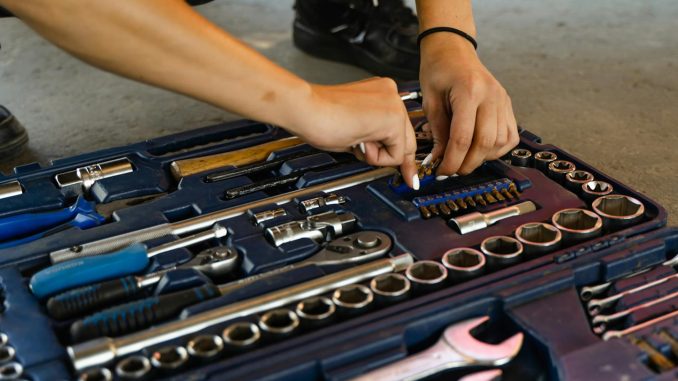
Whether you’re a seasoned electrician, a plumber elbow-deep under a sink, or a carpenter framing a new build, your toolkit is your livelihood. The tools you carry define your capability on the job, your speed, and ultimately your reputation. While every trade has its specialist instruments, there exists a core collection of tools that virtually every tradesperson carries — some obvious, some surprisingly universal. Here’s a thorough look at what fills those heavy toolbags and why.
Table of Contents
The Undisputed Essentials
Hammer
Few tools are more iconic. The claw hammer remains a universal staple across almost every trade — used for driving nails, breaking out materials, and leveraging with the claw to remove fixings. For heavier structural work, a framing hammer with a longer handle and heavier head is preferred. Estwing, an American manufacturer with over a century of heritage, is particularly respected for their one-piece forged steel hammers, which eliminate the weak point of a separate handle and are widely trusted by UK and US tradespeople alike.
Screwdrivers
A full set of screwdrivers — flathead and Phillips (cross-head) at minimum, with Pozidriv and Torx heads increasingly necessary in modern construction and electrical work — is non-negotiable. Quality matters enormously here; cheap screwdrivers cam out, slip, and damage fixings. Wera, a German manufacturer, has built a stellar reputation for precision-engineered screwdrivers with their distinctive Kraftform handles, ergonomically shaped to reduce hand fatigue during sustained use. Their laser-tip technology grips screws firmly, a detail that tradespeople notice immediately.
Tape Measure
Arguably the most-reached-for tool on any site. A robust 5-metre or 8-metre tape measure with a wide, rigid blade that holds its extension is essential. Stanley’s FatMax tapes are practically synonymous with the trade — the wide blade lock and durable casing have made them a default choice for carpenters, joiners, and builders for decades.
Spirit Level
From hanging a radiator to laying a floor, a reliable spirit level is indispensable. Box-section aluminium levels with accuracy-tested vials are the professional standard. Stabila, a German-engineered brand, is considered by many tradespeople to be the gold standard in levels — their precision is trusted on demanding projects where a fraction of a degree matters.
Utility Knife / Stanley Knife
The humble retractable utility knife earns its place in every toolbag. Whether scoring plasterboard, trimming insulation, cutting membrane, or stripping packaging, it’s in constant use across all trades. Stanley — whose name has become so synonymous with this tool in the UK that “Stanley knife” is the common term — produces robust, widely available models.
Power Tools: The Workhorses
Cordless Drill / Driver
The modern cordless combi drill is arguably the single most important power tool a tradesperson owns. Combining drilling and screwdriving functions, with hammer action for masonry, a quality combi drill saves hours on every job. DeWalt and Makita both produce industry-leading cordless drills that have become the dominant choices on UK and European construction sites. DeWalt’s XR brushless range is particularly prized for its power-to-weight ratio and battery longevity, while Makita’s 18V LXT platform is lauded for the sheer breadth of compatible tools available within the same battery ecosystem.
Impact Driver
Often confused with a drill, the impact driver uses rotational impact force rather than pure torque, making it dramatically more effective for driving long screws and fixings into timber without the wrist strain associated with a standard drill. Once a tradesperson uses one, they rarely go back. Both DeWalt and Makita offer exceptional impact drivers within their respective 18V platforms.
Angle Grinder
From cutting metal, tile, and masonry to grinding welds and removing rust, the angle grinder is ubiquitous across construction, metalwork, and plumbing. Bosch Professional (distinct from their consumer range) produces angle grinders that are widely respected for their durability and vibration control, features that matter enormously when using a tool for extended periods on demanding materials.
Jigsaw
Where a circular saw cuts in straight lines, the jigsaw handles curves, cutouts, and awkward shapes in timber, metal, and plastic. Carpenters, kitchen fitters, and general builders rely on it constantly. Bosch Professional’s jigsaws, particularly their barrel-grip models, are lauded for precision and ease of blade changing.
Hand Tools That Every Bag Contains
Pliers and Grips
Combination pliers, long-nose pliers, and a set of adjustable grips (Mole grips or locking pliers) find their way into virtually every trade. Knipex, a German manufacturer, produces pliers that are widely regarded as the finest available — their precision manufacturing and hardened steel make Knipex tools a favourite among electricians, plumbers, and mechanics. A pair of Knipex Cobra water pump pliers, for instance, is considered by many plumbers to be worth every penny of their premium price.
Chisels
Wood chisels for carpenters and joiners, cold chisels for breaking out masonry and concrete — both types are fundamental. A quality set of bevel-edge chisels from Stanley or the more premium Irwin Marples range is a common sight in carpentry toolbags across the UK.
Hacksaw and Hand Saw
Despite the prevalence of power tools, hand saws remain essential — especially in confined spaces where a circular saw can’t manoeuvre. A good quality panel saw for timber and a hacksaw for metal pipes and fixings are still carried by most tradespeople.
Files and Rasps
Used for deburring cut metal pipes, smoothing rough timber edges, and refining shapes, files are a quiet but constant presence. Electricians use them to clean cable trays; plumbers use them after cutting copper pipe; carpenters use rasps for shaping timber.
The Surprising Universals: Tools People Don’t Always Think Of
Pencils and Marking Tools
It sounds obvious, but a sharp carpenter’s pencil or a fine marker is in use constantly on any job — marking cut lines, indicating pipe runs, noting measurements. Many experienced tradespeople carry a Stanley chalk line reel for snapping long straight lines on timber or across floors, a tool that saves enormous time when laying flooring or marking stud positions.
Knee Pads
Not strictly a hand tool, but knee pads are carried by the vast majority of tradespeople who spend time working at floor level — electricians running cables, plumbers beneath boilers, tilers setting floors. Dewalt and Makita both produce heavy-duty knee pads alongside their power tool ranges, and their use dramatically reduces the cumulative joint damage that ends careers prematurely.
A Good Torch / Work Light
Modern LED torches and rechargeable work lights are essential on sites without power, in loft spaces, or in the confined cavities that trades regularly work in. Milwaukee tools have surged in popularity among UK tradespeople in recent years for the quality of the brand’s M18 battery platform. They also produce powerful and durable LED site lights compatible with their battery system.
Pipe and Cable Detection Tools (Multidetectors)
Any tradesperson drilling into walls or cutting into floors needs a cable and pipe detector. Damaging a hidden live cable or water pipe is not only dangerous but expensive. The Bosch Professional D-Tect range and detectors from Stanley are standard equipment that responsible tradespeople never leave the van without.
Magnetic Wristbands and Parts Trays
Small fixings — screws, rawlplugs, cable clips — have a habit of disappearing into carpets and dust. Magnetic wristbands and tray bowls that hold small metal parts are genuinely used daily by electricians, joiners, and mechanics. They’re simple but save real time on every job.
WD-40 and Thread Sealant / PTFE Tape
While chemical products rather than tools per se, no tradesperson’s bag is complete without WD-40 for freeing seized fixings, PTFE tape for sealing threaded plumbing joints, and a tube of appropriate sealant. Plumbers universally carry Fernox products; builders keep Everbuild silicone and adhesives to hand.
Cable Ties and Self-Amalgamating Tape
Electricians and plumbers both rely heavily on cable ties for organising wiring and pipework, while self-amalgamating (self-fusing) tape is used for waterproof repairs, insulating electrical joints, and emergency pipe wrapping. These unassuming items are used on almost every job.
Brand Spotlight: Quality That Tradespeople Trust
A few manufacturers consistently appear in professional toolbags, trusted not for marketing but for genuine performance under daily working conditions:
DeWalt (USA/UK) — Their yellow and black 18V/54V XR brushless range dominates UK sites for power tools. Known for robust build quality and an extensive battery-compatible product line.
Makita (Japan) — The 18V LXT ecosystem is enormous, and Makita’s tools are praised for their precision engineering and longevity. Particularly popular among electricians and carpenters.
Knipex (Germany) — The undisputed premium choice for pliers. Higher initial cost, but tools that last decades with proper care.
Wera (Germany) — Specialist hand tool manufacturer whose screwdrivers and ratchets have developed a loyal following among electricians and engineers for their ergonomics and precision.
Stabila (Germany) — German-engineered levels trusted where accuracy is paramount.
Bosch Professional (Germany) — Distinguished from their consumer blue range by the green Professional branding, their power tools and measuring instruments (laser levels, multidetectors) are staples across all trades.
Milwaukee (USA) — Rising rapidly in UK trade use, Milwaukee’s M18 platform is particularly respected for high-demand tools like reciprocating saws, multi-tools, and site lighting.
The Toolbag as an Investment
What separates a tradesperson’s toolkit from a DIY enthusiast’s collection is not just the number of tools but the quality, care, and intentionality behind each selection. Professional tradespeople buy once and buy well — a quality hammer, a Knipex plier, or a DeWalt drill may cost significantly more than a budget alternative, but it will still be performing reliably ten or fifteen years later.
The tools above represent the collective wisdom of generations of skilled workers — refined by daily use on real jobs, in real conditions, and subjected to the most honest testing environment there is: earning a living.